
I try to be a kind and compassionate person. I attempt to live a lifestyle which strives to reduce the suffering of animals and humans whenever possible. I treat all living beings with the love, care and respect they deserve.
I do not believe, in most cases, there is just pure Black and just pure White in this world: there are shades of Gray. Yes, it can be very dark Gray or very light Gray, but it is Gray nonetheless. I also believe that there is always more than one side to every story. I always try to be empathetic and I try to see the other sides of a situation.
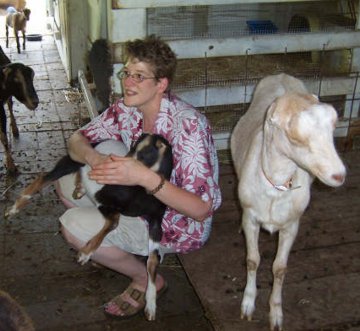 I try to be as good a person as I can, and do what I think is right. As part of trying to help people, I share what I know on my web site. I present my information saying this is how ‘I’ do things. Everybody does things differently, but if I tell you how ‘I’ do it, then you can make up your own mind on how you wish to do things. I just know what works best for my situation. I explain why I do things, and then let others decide what is best for them. I realize there are different situations in life.
There are some people who say drinking milk is wrong. They said milking my goats is wrong. They say "Keeping animals pregnant throughout their lives so we can get their milk" is wrong. There are some who say disbudding a goat is inhumane.
All I can say to this is to please try to look at the other sides of the situations.
I feel I understand a lot about goats. I deal with them on a daily basis. I sit with them and study them. I watch them and learn from them. Goats are very intelligent creatures. They have thoughts and emotions. My life would be sadly empty if goats were not a part of it. I love and care for my goats and their best interest is always at my heart.
I don't breed my goats any more than they would naturally breed in the wild. It is natural for them to breed every year; goats are seasonal breeders (like deer) and breed and give birth once a year. I actually breed my goats less because a goat in the wild would keep breeding every year until they died (probably in childbirth). Here I can retire my does from kidding and milking and let them live out their lives here with love and care. I let my does dry off (stop making milk) naturally when they breed in the Fall, this means they have about 5 months off from milking before they kid, as they would in nature. There are rare exceptions, such as my doe named Peepers, who refused to dry off even though she has no kids, and keeps giving me milk continually. She won't stop no matter how much I ask her to. I am not forcing her to make milk. I have even tried (more than once) to get her to stop, but she likes to give me milk and so I milk her and thank her for it. (I really do say, “Thank you, Peepers.”)
Goats do like having sex, they actually like to get pregnant, and like having their babies. They love their babies. I do not force them to have sex. They do have free will, and if they decide they do not want to have sex with a particular buck they won't. The goat that “suffers” here the most here now is Goldie because she wants very much to get pregnant and have babies, but I won't breed her anymore. By the time Goldie had reached 9 years of age, she had given birth to a total of 22 babies (she always had multiple kids): enough is enough; she’s earned her retirement. But even though she still comes into heat, and very much wants to go on "dates", it is hard not to let her, but it is for he own good not to breed her.
Most does will have babies and produce milk their entire lives, this is natural for them. I retire my does if I feel they should be retired for various health reasons. Some does may never need to be retired. A goat can be productive (and happy about it) their entire life.
I have been accused of "stealing" our goats’ milk and that the babies never get milk from their mothers. This is not the case at all. I do not believe in taking the babies from their mothers at birth (which is a totally different stance than many goat breeders). My goats raise their own kids and we share the doe's milk. Milk for the babies is the first priority; I get what's left. My goats like to be milked and they produce enough milk to feed their babies and share with me. I get a lot of email thanking me for my stance and information because I seem to be the only web site that discusses raising goats with compassion and letting the moms keep their babies. You can get milk in a fair and human manner as a part of a relationship with an animal.
I was a vegetarian, but for health reasons, I do now consume meat, dairy products & eggs. I support small, humane dairies and family farms where the animals are well taken care of and do not suffer because, let's face it, this is real life, and many people are never going to give up eating meat and dairy products. Many vegetarians rely on dairy products, and so, by supporting humane dairies I am doing what I can to help save lives and alleviate suffering. Hindus consume dairy products and also have great love and respect for the animals that provide them. It is possible to do both: consume meat and dairy products and love animals.
I have my chickens and we eat their eggs. Our chickens are quite happy and live a life better than 99.99% of chickens in the world. They will never be killed and eaten. They are never caged or confined. They are free to roam wherever they please, and have their own personal, safe stall in my barn where they choose to sleep and lay their eggs. My chickens lives out their lives here and if they stop producing eggs, that's fine, they provided me what they could, and they are free to just live out their lives. All chickens naturally lay eggs whether there is a rooster around to have sex with or not. I do not keep a rooster and the eggs my chickens lay would never hatch into chicks. By keeping my chickens I am giving a few chickens a better life. They pay for their room and board with their eggs. We humans have to work for a living, it's only fair our animals have to do a little to support themselves here as well.
In regards to the disbudding issue (disbudding means removing their horns by quickly burning off their horn buds when they are very young). I live this issue and have first hand knowledge and experience regarding this, so I am well equipped to be able to see the various sides of this particular situation. I have personally struggled with this issue and after carefully considering and weighing all the options, I have come to the conclusion that it is in the goat's best interest to disbud them. In the long term, they will have not only safer lives (less likely to injure others) but they will also make better herd mates, and safer pets and companions, thus helping to guarantee they can live out their lives in good, loving, caring, permanent homes. Even if the goat is a pet, and friendly, he/she can seriously injure other goats, animals and humans (accidentally, or on purpose) . I can cite many examples of this happening, to humans as well as other animals. Goats learn to use their horns; they can, and will, use them on their herd mates (goats can, at times, be very violent with each other: it is their natural way). Goats with horns can end up in the auction/sale barn because they injured their herd mate, owner or owner's family, and/or could end up living out less then ideal lives, or even being slaughtered. It's certainly better to go through a one time, short, painful experience, then for a herd animal to be penned, or tied out alone, by themselves for the rest of their life, or worse yet, dead. I certainly don't disbud my kids because I enjoy it; I hate disbudding. I do it because it is in the best interest of the goat and is the responsible thing to do as the goat's caretaker. Sometimes life is not all simple & easy/ Black & White. We all go through difficult and painful experiences in our lives- that is the nature of life; in life, there is some suffering for all of us. It is my intent for my kids, that going through one short difficult experience when they are very young will alleviate more painful and difficult experiences later in life. I am being a responsible caretaker, thinking about the long term well being of my charges. I do the job very conscientiously; I do it as quickly as possible, attempting to keep the pain and stress to an absolute minimum. When done correctly the goat suffers no long term negative physical, or emotional, effects from the procedure.
If some people feel it is wrong to have goats for milk and chickens for eggs, that is fine, everyone is entitled to their opinions. I am trying to show people that goats can be treated with love and respect and that there is a kinder way that we can treat all animals. It is possible to get milk and eggs in a humane manner. My goats do like me, and they like to be milked. They make plenty of milk for me and their babies both. By me using their milk, I can do my best to avoid factory farmed milk. I see nothing wrong in having our goats and using their milk.
Be open minded, I say.
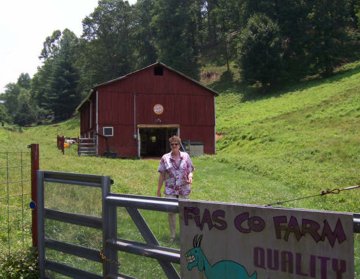 I am lucky in that I have the ability, with the help of my animal friends, to produce what I need here, on my own small humanely oriented farm. I do also understand that not all people are this fortunate. It is next to impossible to avoid all animals based products in this world nowadays because they are everywhere, even in places you would never think. I do the best I can, but I also have to be open minded to different situations and circumstances as well.
If I find a misguided bug in the house I will take him outside; there is no reason to kill him, but I will admit that I use flypaper in the barn, because if we didn't, the barn would be unbearable for the goats. Sometimes we have to do what we have to do. I organically spray a few areas of the garden because if I don't, the insects will destroy plants that are providing me with food for my table. Yes, sometimes it is a tough call, but you have to face the reality of the situation life presents us with. I am willing to share the garden with bunnies; I see no reason to kill them, since bunnies don't destroy the whole garden. We can live peacefully and share.
As I go through this life, I just try to be as kind, compassionate, humane, and also understanding, as I can. We all... all living beings,... are in this together; we aren't just separate waves, but we are all part of the whole ocean.
-Molly Nolte
"The real test of compassion is not what we say in abstract discussions
but how we conduct ourselves in daily life." ~ Dalai Lama
"The greatness of a nation and its moral progress can be judged by the way its animals are treated" ~ Mahatma Gandhi